
How Purpose-Driven Brands Can Build an Organic Social Media Strategy for 2026

This article was written by Planet Media.
In a world where audiences are increasingly discerning, purpose-driven brands have a unique advantage: you’re not just selling products or services — you’re building belief. But belief doesn’t spread on its own. It needs consistency, clarity, and a strategy that balances storytelling with community-building.
We’re Planet Media, a fellow Green Business Network member, and we’ve worked with hundreds of business owners across industries. As an environmentally focused and sustainability-driven organization, we believe in building branding and social media strategies the same way we approach business practices: responsibly, efficiently, and with long-term impact in mind. Just as sustainable choices create lasting value for the planet, smarter branding and social media strategies create lasting value for your business.
As we move into 2026, the landscape of organic social media is shifting. Algorithms are rewarding genuine connections over volume. Creators and brands are collaborating more naturally. And audiences expect transparency, values, and meaningful participation — not just polished posts.
For mission-led organizations, this creates opportunity. But it also requires intention. Here’s how purpose-driven brands can build organic social strategies that don’t just perform, but resonate.
1. Start with Your Brand’s Purpose — Not Platforms
Before choosing content formats or channels, get grounded in why you’re showing up on social at all.
Ask these questions.
What role does social media play in your mission?
What does your audience gain by being connected to you here?
How does your content contribute to the world you’re working to create?
Your social presence should translate your mission into everyday stories and actions — not repeat the “About Us” page.
Example approach:
If your organization stands for regenerative agriculture, your feed should actively show that regeneration in practice — the people, the land, the partnerships — not just state that you care about it. Your mission isn’t a slogan. It’s a lens for every post.
2. Get Clear on Who You’re Talking To
Purpose-driven brands often speak too broadly — “everyone who cares” isn’t an audience.
Define specific communities, such as:
Climate-conscious parents
Designers seeking low-impact materials
Residents near a conservation project
Students and early-career advocates
Then identify:
What they value
What they’re frustrated by
What questions do they ask
What inspires them to take action or share
Your goal is not just to reach. Your goal is resonance.
The more specific your message, the more likely it is to spark conversation, belonging, and momentum.
3. Architect Your Content Around Three Core Pillars
The most effective purpose-led brands don’t post everything about everything. They focus on a few repeated narrative threads.
A strong structure for 2026 looks like:
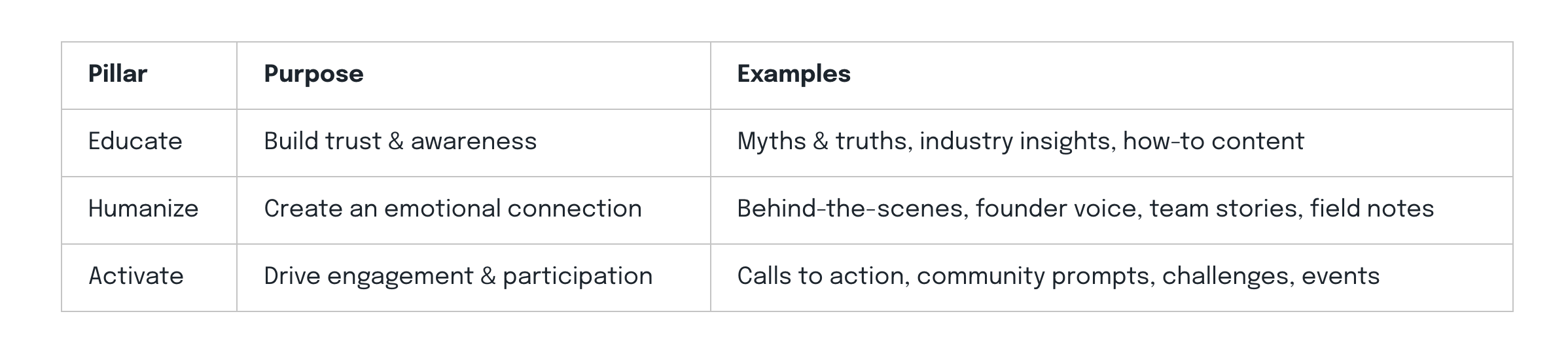
This makes your social presence both recognizable and meaningful.
When people know what to expect from you, they’re more likely to return — and to trust.
4. Prioritize Community Over Virality
In 2026, organic social success is less about going viral and more about building sustained community engagement.
Ways to strengthen community presence:
Respond to comments with intention — not just emojis
Repost user-generated content regularly
Feature partners, collaborators, and your supporters
Create conversation prompts instead of announcements
Host monthly live conversations or AMAs
Purpose builds loyalty. Conversation builds belonging. And belonging drives long-term advocacy.
5. Partner with Creators Who Share Your Values
Influencer strategy isn’t about reach anymore — it’s about alignment.
Look for creators who:
Are genuinely connected to the topic
Are trusted within their community
Communicate with transparency
Create content that feels like life, not ads
Micro-communities can be more powerful than mass audiences, because influence is relational, not transactional.
6. Track What Actually Matters
Traditional social metrics (follower counts, likes) don’t tell the whole story, especially for mission-led brands. Instead, measure indicators of depth and impact, such as:
Saves and shares
Comments with substance (not just emojis)
Repeat engagement from the same users
Community referrals
Partnerships and invitations sparked by your content
In other words: measure connection, not just attention.
7. Show Progress, Not Perfection
Purpose-driven brands sometimes hesitate to post because “we’re not there yet.” But transparency is more engaging than polished outcomes. Share your work-in-progress:
What you’re learning
What changed your mind
Where progress slowed
What you’re improving
Imperfection is relatable. Honesty is credible. Movement builds momentum.
The Bottom Line
Organic social media in 2026 favors brands that are:
Clear about their purpose
Present in the community, not just broadcasting
Transparent in voice and values
Consistent in storytelling
Rooted in real-world action
When your social presence reflects who you really are and what you truly care about, your audience doesn’t just watch — they join. Because purpose isn’t something you declare, it’s something you demonstrate — post by post, conversation by conversation, choice by choice.
Planet Media is a green, eco-friendly, and sustainability-focused creative agency at the intersection of art, design, and technology. We support organizations that prioritize sustainability—to define and enhance their identity, positioning, and market visibility.